
The Missing Peace & How to Find It
Exploring mistakes and discoveries on the journey to shalom
The Challenge
The world is unraveling in real time.
We are peacemakers, but not the kind who mistake silence for peace. At Blessed Are the Peacemakers, we wrestle with what it means to follow Jesus in a world unraveling at the seams — refusing to let faith be co-opted by nationalism or wielded as a weapon of exclusion. Instead, we seek a faith that resists injustice, builds bridges, and makes space for shalom in the places it feels most impossible.
We are committed to courageous witness and education--to awaken, embody, and amplify peace where walls, injustice, and silence prevail. Our particular focus begins in Palestine. Literally in our on-going peacemaking efforts, but also as a prism through which we see other spaces and places that have a peace deficit.
Gaza has become the modern version of “the killing fields” — a phrase originally used to describe the mass executions under Pol Pot’s Khmer Rouge regime in Cambodia. Today, it continues, even if we are told there is a ceasefire. Relentless bombardment and siege conditions have turned Gaza into a place of unimaginable suffering, while the West Bank faces an unrelenting surge of violence and displacement. I experienced this reality firsthand while visiting in November 2025. The horror of October 7th — when Hamas killed civilians and took hostages — was met with a devastating response that has killed tens of thousands and displaced nearly the entire population of Gaza. State-backed settler violence in the West Bank escalates unchecked.
And now the horizon has widened. Missiles are falling on Iran. Children are dying in Tehran as they have died in Gaza City and Jenin. The geography shifts, but the logic of violence remains the same: overwhelming force justified by security, wielded against civilians, condemned by some and cheered by others along predictable ideological lines. We refuse that script.
This crisis is often reduced to a narrative about Israel’s security needs — or, now, about stopping a nuclear threat — with every human cost framed as unfortunate but necessary. Such framing ignores the decades of occupation, systemic dispossession, and daily violence that set the stage for the current catastrophe. It ignores what it does to a people to live under the threat of annihilation. And it ignores us — the church — which has too often provided the theological cover for empire to do its worst.
Back home, Christian Nationalism is reshaping the political and moral landscape of the U.S., just as Christian Zionism fuels oppression in Palestine and gives moral blessing to what is happening now across the region. Conversations on justice, peace, and even basic human rights are twisted, silenced, or hijacked by fear-mongering and misinformation.
But if injustice is contagious, so is hope. The forces that sustain violence are deeply connected, but so are the ones that build peace. Love spreads. Justice takes root. Shalom catches like wildfire, seeping through the cracks of despair, breaking through walls — both physical and ideological. It is not naïve or wishful thinking; it is the compelling alternative to a world bent on division and destruction. And we’ve seen it in action.
While much of our recent focus has been on Palestine, the struggle for justice and the work of peacemaking extend far beyond it. The same patterns of oppression at play there surface in other places, just as the small acts of defiant, everyday kindness we witness in Palestine ripple outward, inspiring resistance and renewal across the world. Peacemaking is never just about one place; it’s about choosing, wherever we are, to resist fear and embody a love that disrupts the status quo.
And really — who refuses a piece of knafeh once they’ve tasted it? Some things are just too good not to share.
So what do we do? And perhaps the harder question — what are we willing to sacrifice to make a difference?
The Question That Changed Everything
Several years ago, on a flight from Argentina, I found myself next to a man reading God Is Not Great by Christopher Hitchens. I nearly avoided conversation, expecting a debate. But curiosity won.
We talked about my work as an ordained minister engaged in peacemaking. Then he hit me with this:
“Why are the most religiously devout the ones most bent on destroying the world? Why are they ready for war, not peace?”
I didn’t take it as a personal attack. I took it as an invitation.
That question revealed a glaring disconnect — not just between our faith communities and Jesus’ radical call to peacemaking, but between the Gospel we had been taught and the Gospel of the Kingdom that Jesus actually proclaimed. A Gospel that calls not just for personal salvation, but for a world reordered toward justice, reconciliation, and the flourishing of all people.
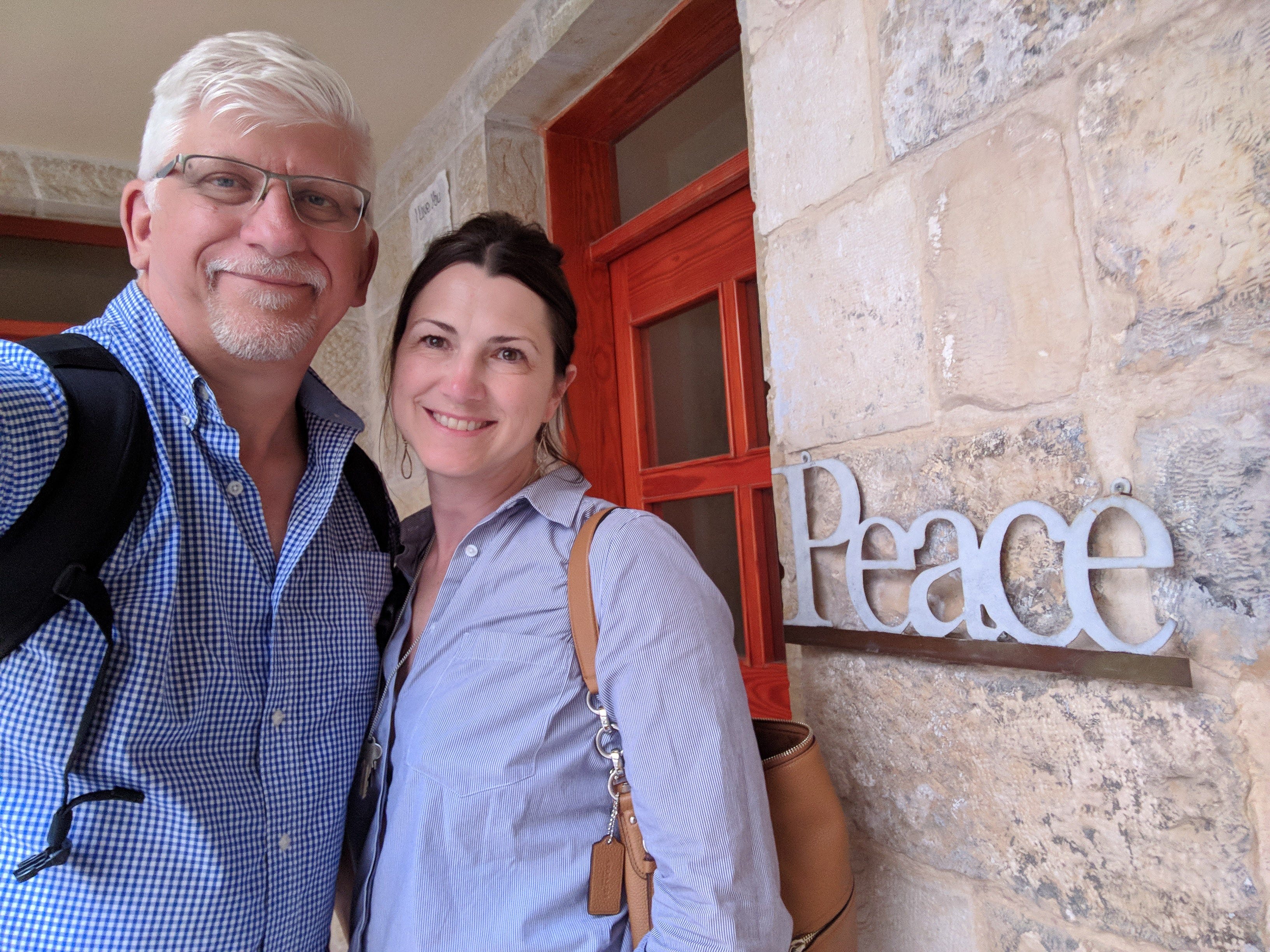
That conversation lingered. It sparked late-night talks with Cari and led us to “come out” as advocates for a peace that insists on truth, on liberation, on a justice that heals wounds rather than deepening them.
Our Story
Cari and I, like many, find ourselves at a crossroads.
We were raised in church traditions that emphasized personal salvation, evangelism, and conversion — often at the expense of justice, reconciliation, and holistic peace. Especially for brown and black people. We were taught that Jesus was the answer, but too often that answer was filtered through cultural assumptions rather than the radical, boundary-breaking love of Christ himself.
But the Spirit has been nudging us into something deeper. Something more expansive than we once imagined.
We still love Jesus. We still belong to a faith community. We still speak in churches. But we can’t shake the unease — the way the church often mirrors the world’s divisions rather than Jesus’ enemy-loving way of peace. We’ve had to unlearn bad theology — harmful interpretations that distort the Gospel and violate what should be a spiritual Hippocratic oath: Do no harm.
We haven’t abandoned our roots — we’ve returned to the person of Jesus, beyond the layers of cultural Christianity that often obscure his message. This journey has led us to unexpected places where Christ was already moving, inviting us into his ministry of reconciliation. Our faith hasn’t diminished; it has deepened. And along the way, we’ve found a community that includes both familiar faces and those we never expected to meet.
Does this resonate with you?
What We’ve Learned
This space is one of many where we seek to lead the conversation and invite others into an expanding coalition of the willing — those who refuse to accept the world as it is and instead work toward what it could be.
While there are Christians deeply committed to reconciliation, we’ve also seen how the church often prioritizes belief over discipleship, personal piety over public justice, and evangelism over embodied love. But Jesus’ way of peace is not just about internal transformation — it’s about radical hospitality, enemy love, and a justice that heals rather than harms.
We’ve also found that many of our Jewish, Muslim, atheist, and agnostic friends are just as committed to peacemaking as we are. They, too, are seeking shalom.
Our Hope
We refuse to look away. We believe the way of Jesus is still good news — but not the domesticated, power-serving version too often preached. We’re talking about the Jesus who overturned tables, challenged empire, and called for a love so disruptive it could heal the world.
We don’t just wrestle with these questions; we step into them. We look for practical pathways to peace — not the kind that smooths over injustice, but the kind that insists on truth, liberation, and the hope that does more than wish.
But what is peace, really? (Check out where we explored some initial thoughts.)
We don’t just want to deconstruct. We want to build something life-giving.
With Bibles in hand and crises all around, we invite you to journey with us — guided by a simple truth scrawled on the wall in Bethlehem:
“Make Hummus, Not Walls.”
Why Subscribe? What to Expect
By subscribing to Blessed Are the Peacemakers, you’ll engage in essential conversations on peacemaking, justice, and the visual storytelling of Andy’s photography. Specifically, you’ll find:
A theological framework for peacemaking
Commentary on the culture and communities we’ve engaged
Insights into what peacemaking is not
Reflections on the interfaith dimensions of justice and reconciliation
Stories & visuals from Andy’s work in visual peacemaking
Deep dives into challenging topics like the Israeli occupation, demolitions, checkpoints, and illegal settlements
Explorations of visio divina, using photography as a contemplative practice
Cari’s perspective as a civilian peacemaker
Curated recommendations on movies, podcasts, and resources
What We Do: Witness. Awaken. Empower.
These three words guide everything we do — not just as ideas, but as actions.
1. Witness Seeing, listening, and acknowledging injustice and beauty alike. Witnessing isn’t passive — it’s an act of presence, a commitment to amplifying voices that must be heard.
In action: Documenting Palestinian life under occupation. Standing in solidarity, bringing their stories into overlooked spaces. Sometimes in the pulpit. Sometimes in the streets. Sometimes with a Congressional Representative. Always in the quiet work of writing, reflection, and prayer.
2. Awaken Stirring hearts and minds to recognize our shared humanity. Awakening moves people from indifference to engagement, helping them see the world through new eyes.
In action: Using storytelling, theology, and creative media to shift perspectives. Inviting people beyond stereotypes, despair, and fear toward hope and connection.
3. Empower Giving people the tools, insights, and confidence to create change.
In action: Offering practical ways to support peacemaking — through solidarity trips, advocacy, and financial contributions. Equipping people to believe they can make a difference.
Each of these is part of a bigger story — a story of showing up, speaking out, and building bridges in a divided world.
Join Us
You’re not alone.
If you’ve felt the tension between the Jesus of the Gospels and the Christianity you’ve encountered — if you’ve wondered whether faith could be something more — know that you’re not alone.
The Holy Spirit is still moving. Still inviting. Still calling us deeper into the way of Jesus.
Let’s rediscover the missing peace — together.
Subscribe to get full access to the newsletter and publication archives. Purchase a paid subscription if you think we are adding value to your journey and want to throw a tip our way.
Stay up-to-date
Never miss an update—every new post is sent directly to your email inbox. For a spam-free, ad-free reading experience, plus audio and community features, get the Substack app.
